
LED vs. Neon: The Real Cost and Look of Lit Signs
Published June 30, 2026
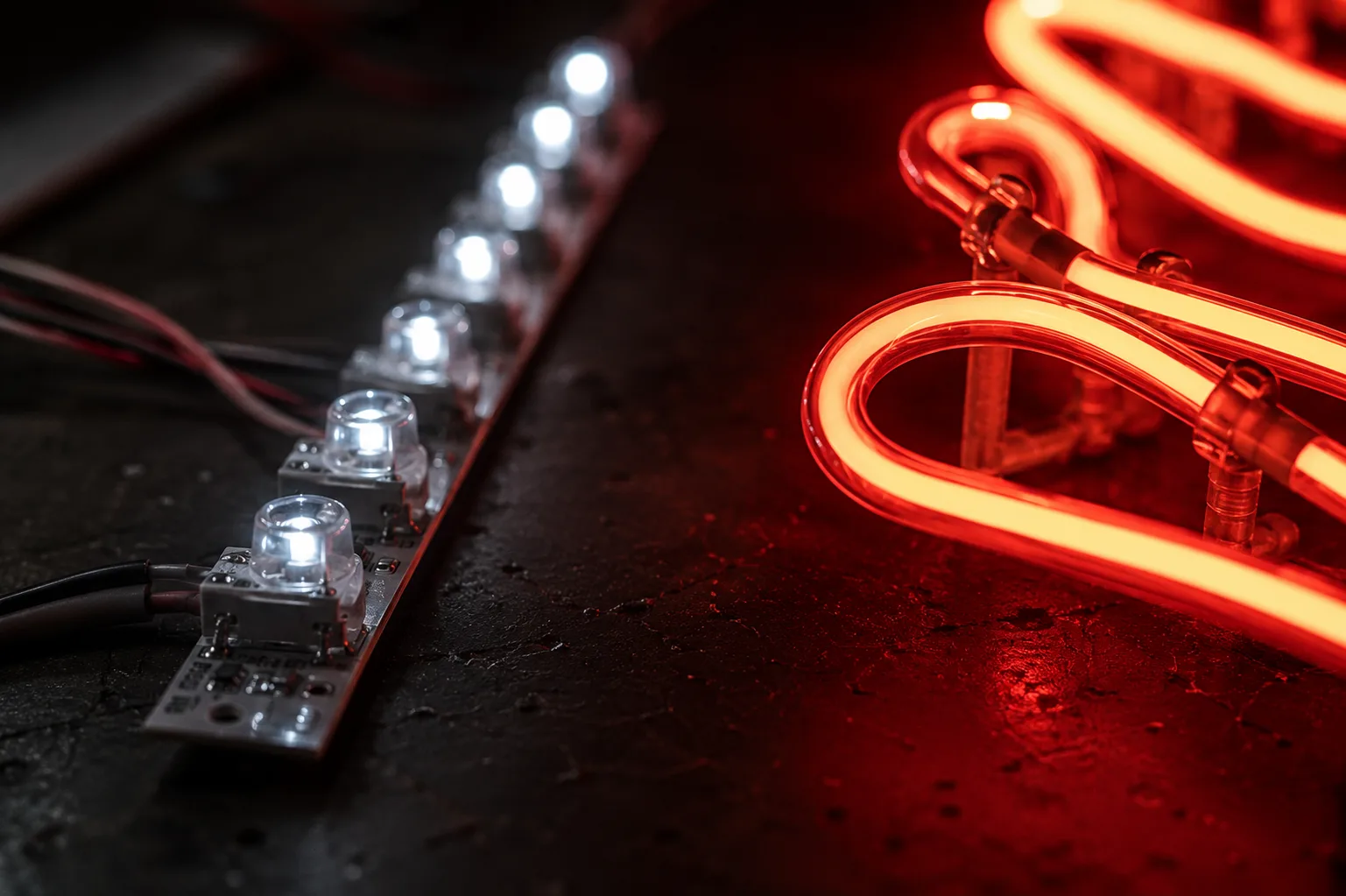
When people picture a glowing sign, they often picture neon — but nearly every illuminated sign built today uses LED. Both can produce that bright, colourful glow. The difference shows up in the running cost, the lifespan, and what happens when something breaks.
Running cost and lifespan
LED wins decisively on both. Modern LED modules use roughly 90% less power than the transformer-driven glass tubes of traditional neon, and they last 50,000 hours or more — around 15 years at typical business hours. Real neon runs hot, draws far more power, and its tubes gradually dim and fail.
For a business paying the hydro bill, an LED channel-letter sign costs only a few dollars a month to run. That difference adds up over the life of the sign.
The look
Traditional neon has a specific, warm, continuous glow that enthusiasts love — and for a few heritage or design-forward brands it is worth the trade-offs. But 'neon-look' LED (flexible LED strip that mimics a neon tube) has become good enough that most people cannot tell the difference from a few feet away, at a fraction of the cost and none of the fragility.
Maintenance and safety
Neon tubes are glass and gas under high voltage — fragile, and a repair means a specialist re-blowing a tube. LED modules are low-voltage, solid-state, and individually replaceable. If one section of an LED sign ever fails, it is a quick swap, not a rebuild. LED also runs cool, which is easier on the acrylic faces and safer overall.
The bottom line
For almost every business, LED — or neon-look LED for that retro glow — is the right call: lower running cost, far longer life, easier maintenance, and a look that is now indistinguishable to most eyes. We build in both, but we will always tell you honestly when LED is the smarter spend for your project.