Blade & Projecting Signs in Montreal: The Storefront Guide
Published November 14, 2026
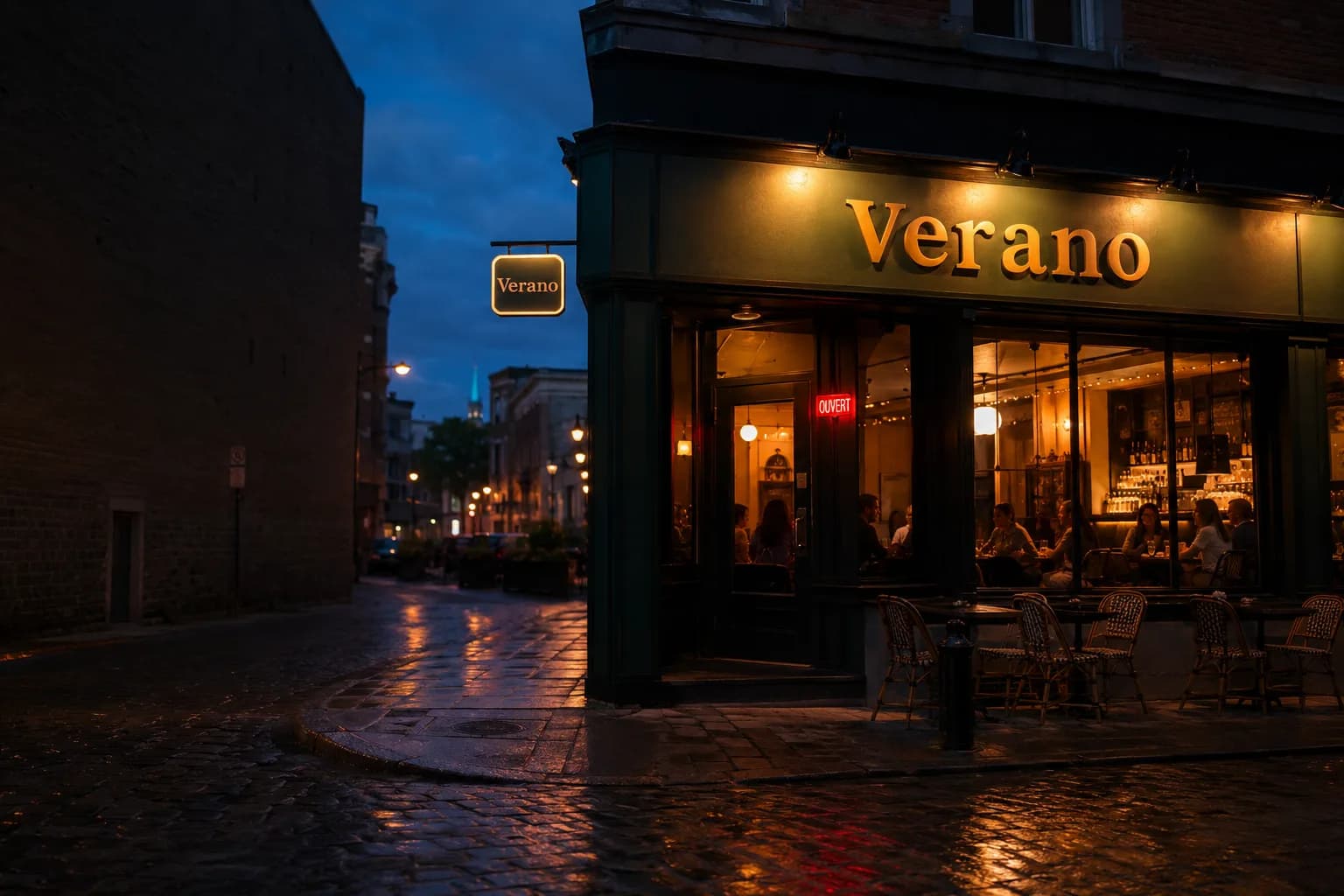
A flat facade sign is built to be read from across the street. A blade sign is built to be read from directly below it, by the pedestrian already walking past your door. In dense, walkable Montreal neighbourhoods, that perpendicular angle is often what actually pulls someone in. Here is how blade (projecting) signs work, where they shine, and the one permit rule that catches owners off guard.
Quick answer
A blade (projecting) sign mounts at a right angle to your wall so pedestrians see it head-on along the sidewalk, the counterpart to a flat facade sign. Because it projects over the public sidewalk, most Montreal boroughs regulate projection and clearance separately and may require a permit. We design, build, and install them, get a free mockup.
What is a blade sign?
A blade sign, also called a projecting or perpendicular sign (enseigne en saillie), mounts at a right angle to your building, sticking out over the sidewalk so it is visible to people walking along it. It is the counterpart to a facade sign: where the facade sign faces the street, the blade sign faces the foot traffic.
Blade signs are usually smaller than facade signs and hang from a decorative bracket or a simple arm. They can be double-sided so they read coming and going, illuminated or not, and shaped to your brand, a classic rectangle, a custom silhouette, or a hanging panel under an arm.
Why blade signs work
The math is simple: a pedestrian walking toward your storefront sees a flat facade sign only at a sharp, shrinking angle until they are almost past it. A blade sign sits in their natural sightline the whole approach. On a busy sidewalk, the Plateau, Mile End, Saint-Denis, the Main, that is the difference between being noticed from 30 metres away and being noticed too late.
They also add character. A well-made blade sign reads as established and intentional, which is why cafés, bookshops, bars, and boutiques lean on them. Paired with a facade sign, they cover both the across-the-street view and the on-the-sidewalk view at once.
Types of blade signs
Non-illuminated blade signs are dimensional panels or cut metal shapes on a bracket, the lowest-cost, most heritage-friendly option. Illuminated blade signs add visibility after dark: edge-lit or push-through acrylic for a modern look, or a backlit cabinet blade for maximum punch. Neon-look LED blade signs give that retro glow restaurants and bars love, with LED reliability instead of real neon's fragility.
Construction is weatherproof by necessity, aluminum or steel brackets rated for wind load and Quebec freeze-thaw, sealed electrical for lit versions, and finishes that survive road salt and sun. Double-sided is standard, since the whole point is to be read from both directions along the sidewalk.
| Style | Look | Illuminated? |
|---|---|---|
| Dimensional panel | Classic, heritage-friendly | No |
| Edge / push-through acrylic | Modern, clean | Yes |
| Backlit cabinet blade | Maximum visibility | Yes |
| Neon-look LED | Retro glow | Yes |
The permit rule that catches owners off guard
Here is the part people miss: a blade sign projects over the public sidewalk, which is city property. That makes it an encroachment on the public right-of-way, and most Montreal boroughs regulate it separately from a flat facade sign, with limits on how far it may project, how high the bottom edge must sit above the sidewalk (for clearance), and sometimes a separate occupancy or encroachment permit.
It is entirely doable, blade signs are everywhere in Montreal, but it is not automatic, and the rules differ by borough. We check the projection and clearance limits for your specific address, prepare the drawings, and can file the application on your behalf. As always, the borough makes the final call.
Where blade signs work best
Blade signs earn their keep on high-foot-traffic streets where customers arrive on foot: restaurant and café strips, retail main streets, bars and nightlife districts, and professional offices in walkable cores. They are especially effective in heritage districts like Old Montreal, where a tasteful projecting sign fits the streetscape better than a large illuminated facade box.
They are less useful for car-oriented locations, a strip mall or a boulevard storefront set back behind parking is better served by a facade sign or a pylon, where a small perpendicular sign would simply be too far from the road to read.
Pairing a blade sign with your facade sign
The strongest storefronts use both: a facade sign for the across-the-street and passing-car view, and a blade sign for the on-the-sidewalk approach. Designed together, same colours, same logo treatment, complementary scale, they reinforce each other instead of competing. If you are planning a new storefront, ask for a free 3D mockup showing both on a photo of your actual building, so you can see the full identity before you commit.
Frequently asked questions
What is a blade sign?
A blade sign, also called a projecting or perpendicular sign (enseigne en saillie), mounts at a right angle to your building so people walking along the sidewalk see it head-on. It's the counterpart to a flat facade sign.
Do blade signs need a special permit in Montreal?
Often, yes. Because a blade sign projects over the public sidewalk, most boroughs regulate projection distance and minimum clearance separately and may require an encroachment permit. We check your address and can file for you, see the permit guide.
Can I have both a blade sign and a facade sign?
Yes, and the strongest storefronts use both, a facade sign for the across-the-street view and a blade sign for the sidewalk approach. Get a free 3D mockup showing both on your building.